Your Website Is Invisible to ChatGPT — and It Is Costing You Customers Right Now
Search did not die. It moved. Here is what the 2026 data actually shows about AI search, and the eight-step playbook for getting your business cited by ChatGPT, Gemini and Google AI Overviews.
Open ChatGPT right now and type: "best web design agency in Dubai" or "top ecommerce developers in Germany". Read the answer carefully.
Your company is probably not in it. Three or four competitors are — and some of them are smaller than you, with worse portfolios and fewer clients.
That answer was not generated by accident. It was assembled from sources the model considered trustworthy, and every one of those sources is now receiving enquiries that would once have come to whoever ranked first on Google. This is the quietest and most expensive shift in digital marketing since mobile, and most businesses have not noticed it happening.
The Numbers Nobody Wants to Show You
The Pew Research Center tracked the real browsing behaviour of 900 adults across 68,879 Google searches. The findings are stark:
- When an AI summary appeared, users clicked a traditional search result in just 8% of visits. Without an AI summary, they clicked 15% of the time — nearly twice as often.
- Users clicked a source cited inside the AI summary in only 1% of visits.
- After seeing an AI summary, 26% ended their browsing session entirely, compared to 16% on a traditional results page.
Read that middle statistic again, because it is the one that reframes everything. Being cited by an AI engine rarely produces a click. It produces something else — a recommendation, delivered privately, by a system the user already trusts.
The old model was: rank first, get the click, make the sale. The new model is: get cited, become the recommendation, and receive the customer later — through a direct visit, a branded Google search, or an email that begins "ChatGPT suggested I contact you."
If you are only measuring clicks, this shift looks like a catastrophe. If you understand what is replacing them, it is the largest unclaimed opportunity in your market.
Why This Hits the Gulf and Europe First
AI adoption is not evenly distributed, and the imbalance works dramatically in favour of businesses in these two regions.
According to Microsoft’s AI Diffusion Report for Q1 2026, measuring the share of working-age adults using AI tools regularly:
- United Arab Emirates: 70.1% — the highest adoption rate on earth
- France: 47.8% · United Kingdom: 42.2% · Netherlands: 42.1%
- Germany: 31.1% · Saudi Arabia: 29.4%
- Global average: 17.8%
Seven out of ten working adults in the UAE use AI tools regularly. That is roughly four times the global average. When someone in Dubai needs a supplier, an agency, a clinic or a law firm, there is now a very strong chance the first place they ask is not Google — it is a chat window.
The same is increasingly true across Western Europe, where adoption sits between two and three times the global norm. Your buyers have already changed their behaviour. Most of your competitors have not changed their marketing.
The Good News: AI Traffic Converts Far Better
Here is the part that turns this from a threat into a business case. The visitors AI engines do send are exceptional.
- A study of 312 B2B firms by Opollo found AI-referred traffic converted at 14.2%, against 2.8% for organic search — roughly a 5x difference (January 2025 to January 2026).
- Seer Interactive recorded conversion rates by platform for a B2B client: ChatGPT 15.9%, Perplexity 10.5%, Claude 5.0%, Gemini 3.0%.
- SE Ranking found AI-referred visitors spend 68% more time on site than organic visitors.
- Adobe Analytics measured a 42% higher conversion lift for AI traffic against baseline in US retail, Q1 2026.
The logic is simple. Someone arriving from a Google results page is still comparing. Someone arriving from ChatGPT has already been told, by a source they trust, that you are the right answer. They arrive pre-sold.
AI referrals currently account for only about 1% of total traffic across industries, rising to 2.8% in technology sectors (Conductor). That number is small, growing fast, and worth several times its weight. ChatGPT alone drives roughly 87% of all AI referral visits, which means most of the opportunity sits behind a single door.
How AI Engines Actually Decide Who to Cite
This is where most agencies are still guessing, and where the data is genuinely surprising.
Ahrefs analysed what correlates with brand visibility across ChatGPT, Google AI Mode and other engines. The ranking of factors, by correlation strength:
| Factor | Correlation with AI visibility | What it means |
|---|---|---|
| YouTube mentions | 0.712 – 0.740 | Strongest single correlate |
| Branded web mentions | 0.656 – 0.709 | Being talked about, linked or not |
| Branded anchors | 0.511 – 0.628 | Links using your brand name |
| Branded search volume | 0.352 – 0.466 | People searching for you by name |
| Domain Rating (DR) | 0.266 – 0.326 | Classic authority score |
| Backlinks | ~0.200 | Weak |
| Number of pages on site | ~0.194 | Effectively negligible |
Two conclusions follow, and both are uncomfortable for traditional SEO.
Being talked about beats being linked to. Branded web mentions correlate roughly three times more strongly with AI visibility than backlinks do. Language models are trained and grounded on text about your brand — reviews, listicles, forum threads, news coverage, comparison articles. A mention of your company name in a "top 10 agencies in Dubai" article, with no link at all, appears to be worth more to an AI engine than a dofollow link from a directory nobody reads.
Volume of content is close to irrelevant. The number of pages on your site showed almost no relationship to AI visibility. The programmatic-content strategy that worked in 2019 does nothing here.
One honest caveat: these are correlations, not proven causes. Well-known brands get mentioned on YouTube and get cited by AI for the same underlying reason — they are well known. But the direction of travel is unmistakable, and it points at reputation rather than link building.
The Eight-Step AI Search Optimization Playbook
1. Check that you are not blocking AI crawlers
Start here, because it takes ten minutes and a surprising number of sites fail it. Visit yourdomain.com/robots.txt and look for disallow rules affecting GPTBot, OAI-SearchBot, ChatGPT-User, ClaudeBot, PerplexityBot, Google-Extended or CCBot. Many security plugins, CDN "bot protection" presets and well-meaning developers blocked these in 2024 and 2025. If you are blocking them, you have opted out of AI search entirely — and no amount of content will fix it.
2. Restructure content to be answer-first
AI engines extract passages, not pages. The structure that gets extracted is consistent: a clear question as a heading, followed immediately by a direct, self-contained answer of roughly 40 to 60 words, followed by the supporting detail.
Bury your answer in paragraph seven after a story about your founder and it will never be quoted. Lead with it and it becomes citable.
3. Make your identity machine-readable with schema
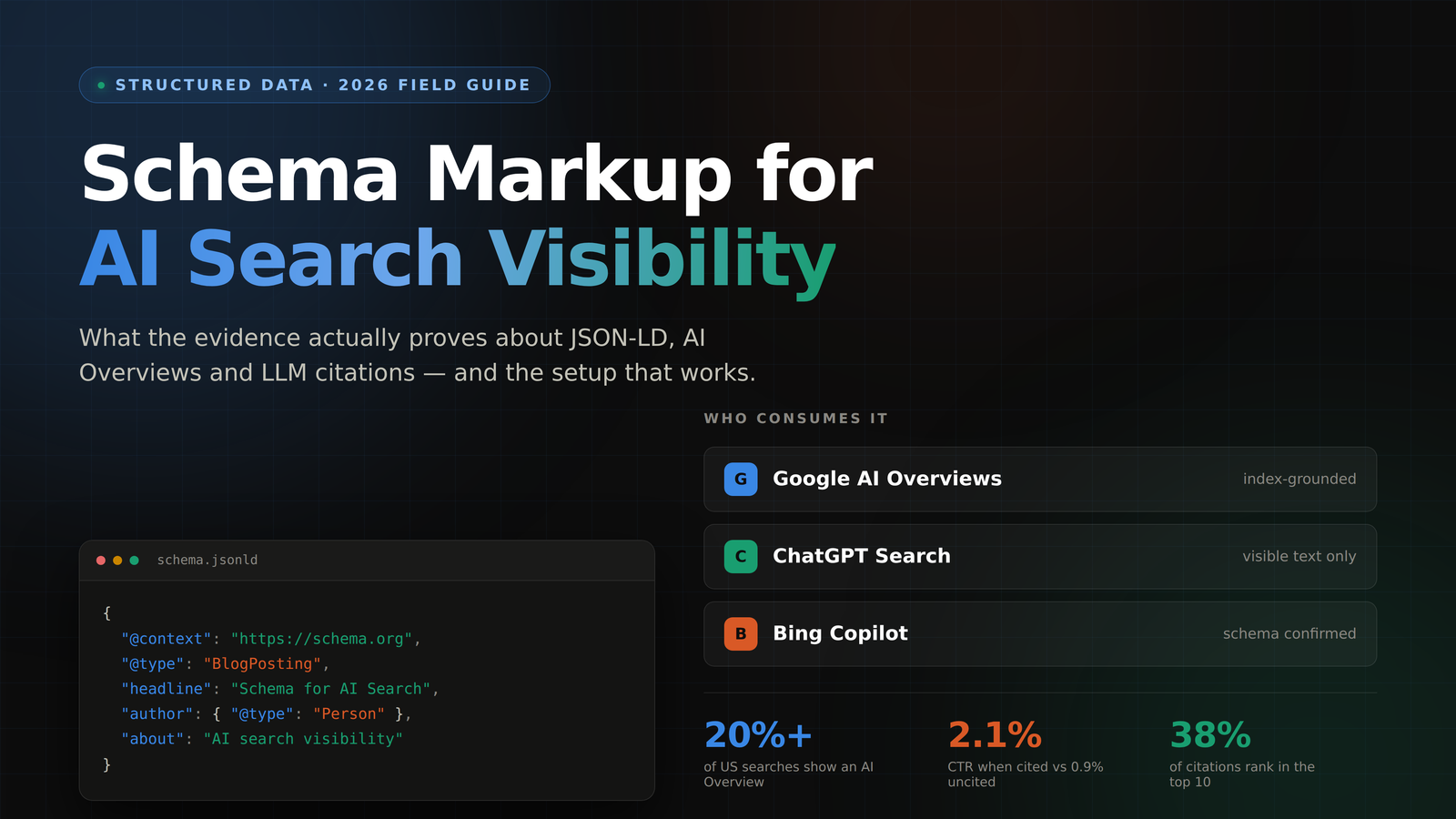
Structured data is how you tell a machine what you are rather than hoping it infers correctly. Implement Organization schema with your official name, logo, founding date and sameAs links to every profile you own; LocalBusiness with accurate address and service areas; FAQPage on articles; Article with author and dates; and Product or Service where relevant. This is cheap, permanent and almost universally neglected outside enterprise.
4. Build mentions, not just links
Given what the correlation data shows, this is the highest-leverage activity available. Get your business named in industry roundups and "best of" listicles. Answer questions genuinely on Reddit, Quora and regional forums. Pitch commentary to trade publications. Claim and complete every credible directory in your market — Clutch, GoodFirms, regional chambers of commerce, Gulf and EU business listings. Encourage reviews with substance, not just star ratings.
You are no longer building a link profile. You are building a body of text about your company that models can read.
5. Take YouTube seriously
YouTube mentions showed the single strongest correlation with AI visibility in the Ahrefs data. You do not need production values — you need to exist there, be named, and be described accurately. Short explainer videos, client walkthroughs, and appearances on other people’s channels all count.
6. Fix your entity across the web
AI engines resolve businesses to entities. Inconsistency breaks that resolution. Use exactly the same company name, address and phone number everywhere. Complete your Google Business Profile, LinkedIn company page, Crunchbase entry and Wikidata item if you qualify. If three sources describe your company three different ways, the model has no confident answer to give — so it gives someone else’s.
7. Get serious about Bing again
ChatGPT’s search grounding leans heavily on Microsoft’s index. If you are not in Bing, you are largely invisible to the platform that drives the overwhelming majority of AI referrals. Set up Bing Webmaster Tools, submit your sitemap, and enable IndexNow so new pages are discovered within minutes rather than weeks.
8. Serve clean, fast, server-rendered HTML
Most AI crawlers do not execute JavaScript the way Googlebot does. If your content only appears after a client-side render, there is a real chance the crawler sees an empty shell. Server-side rendering, fast responses and clean semantic HTML are no longer just performance concerns — they determine whether your content exists at all from a machine’s point of view.
Do You Need an llms.txt File? The Honest Answer
You will see agencies selling llms.txt as essential. Here is the actual position as of 2026.
Google says no. Google’s AI optimization guidance states plainly that llms.txt is not needed for AI Overviews, AI Mode or any other generative search feature. John Mueller compared it to the old keywords meta tag, noting that AI services were not requesting the file. Gary Illyes confirmed Google is not pursuing it.
Some AI companies do use it. Anthropic recommends it in its guidance for agent-readable content, OpenAI maintains llms.txt files for its own developer products, and Perplexity has been observed surfacing llms.txt content.
The verdict: it costs an hour and it will not hurt you. It is genuinely useful if you publish documentation or want to be usable by AI agents. It will do nothing for your Google visibility, and anyone selling it as an AI-SEO silver bullet is selling you a meta keywords tag in 2026 packaging.
How to Measure AI Visibility
You cannot improve what you do not track, and none of this appears in a standard analytics report by default.
- GA4 referral segments. Build a segment for
chatgpt.com,perplexity.ai,gemini.google.com,claude.aiandcopilot.microsoft.com. Watch it monthly. Only about 14% of marketers currently track AI search as a separate channel, which tells you how much of a head start is available. - Prompt testing. Write down the 20 questions a real customer would ask an AI before hiring someone like you. Run them monthly across ChatGPT, Gemini, Perplexity and Copilot. Record whether you are named. This is your new rank tracker.
- Server logs. Look for
GPTBot,OAI-SearchBot,ClaudeBotandPerplexityBotuser agents. Rising crawl frequency is the earliest available signal that your work is landing. - Branded search and direct traffic. Because AI citations so rarely produce a direct click, a rise in people searching your company name is often the true measure of AI visibility.
Frequently Asked Questions
What is Answer Engine Optimization (AEO)?
Answer Engine Optimization is the practice of structuring your website and online presence so AI systems such as ChatGPT, Gemini, Perplexity and Google AI Overviews cite your business in their answers. It is also called Generative Engine Optimization (GEO). It complements traditional SEO rather than replacing it.
Why does ChatGPT not know about my business?
Usually one of four reasons: you are blocking AI crawlers in robots.txt, your site is not indexed in Bing, your brand is rarely mentioned on third-party sites the model can read, or your content is not structured in a way that can be extracted as an answer.
Is SEO dead in 2026?
No. AI engines still ground their answers in indexed web content, so crawlability, structure, authority and speed all still matter. What has changed is the goal: you are optimising to be quoted as well as clicked.
How long does it take to appear in AI search results?
Technical fixes such as unblocking crawlers and adding schema can show effects within two to six weeks. Reputation work — mentions, reviews, third-party coverage — typically takes three to six months, because it depends on other people publishing about you.
Do backlinks still matter for AI visibility?
They matter, but far less than for classic rankings. In the Ahrefs correlation data, backlinks scored around 0.2 while branded web mentions scored 0.66 to 0.71. Unlinked mentions of your brand name now carry real weight.
Should I block AI crawlers to protect my content?
That is a legitimate choice for publishers who sell content, but for a business that sells products or services it is self-defeating. Blocking GPTBot removes you from the answers your customers are reading.
How do I track traffic coming from ChatGPT?
In GA4, create a segment or report filtered by session source containing chatgpt.com, perplexity.ai, gemini.google.com or claude.ai. Watch direct traffic and branded search alongside it, since many AI-influenced visitors arrive without a referrer.
Does AI search matter for local businesses?
Very much so, particularly in high-adoption markets like the UAE. Local questions — "best dentist near Business Bay", "reliable movers in Amsterdam" — are exactly the kind AI assistants answer confidently, and the answer is usually drawn from reviews, directories and structured local data.
The Bottom Line
The businesses winning in AI search right now are not the ones with the biggest content budgets. They are the ones that made themselves easy for a machine to read, understand and trust — while everyone else was still arguing about keyword density.
The window is unusually wide. Only about 30% of brands maintain any consistent visibility in AI answers, and only 14% of marketers track AI search as a channel at all. In two years this will be table stakes and expensive. Today it is a technical checklist and a reputation strategy that most of your competitors have not started.
Go and ask ChatGPT who the best provider in your category is. Whatever it says is the honest state of your brand in the eyes of the systems your customers now use. If the answer is somebody else, that is not a verdict — it is a to-do list.
Find out what AI actually says about your business
HexisBot builds fast, machine-readable, high-converting websites for businesses across Europe and the Gulf. Request a free AI Visibility Audit and we will run 20 real customer prompts across ChatGPT, Gemini, Perplexity and Copilot, check whether you are blocking AI crawlers, review your schema and entity consistency, and send you a prioritised action plan showing exactly why you are — or are not — being recommended.
Tagged with:
nswer engine optimization
generative engine optimization
GEO
AEO
AI SEO
how to get cited by ChatGPT
AI search optimization
Google AI Overviews optimization
ChatGPT SEO
AI search visibility
llms.txt
schema markup for AI
brand mentions SEO
zero-click search
GPTBot robots.txt
AI SEO services Dubai
generative engine optimization UAE
AI search optimization Saudi Arabia
AEO agency Europe
Bing Webmaster Tools IndexNow


Leave a Comment
Share your thoughts. No account needed — just your name, email, and comment.
Comments (0)