Schema markup is code you add to your website that tells search engines and AI assistants exactly what your content is — who wrote it, what you sell, where you are located, and what question each section answers. In 2026 it does not guarantee you a spot in an AI answer, but it removes the guesswork that stops machines from understanding your business at all.
This guide is written for business owners, not developers. You will get plain-English explanations, copy-and-paste code, an honest read on what the evidence says, and a checklist you can hand to whoever manages your site.
Quick Answer: Does Schema Markup Help With AI Search Visibility?
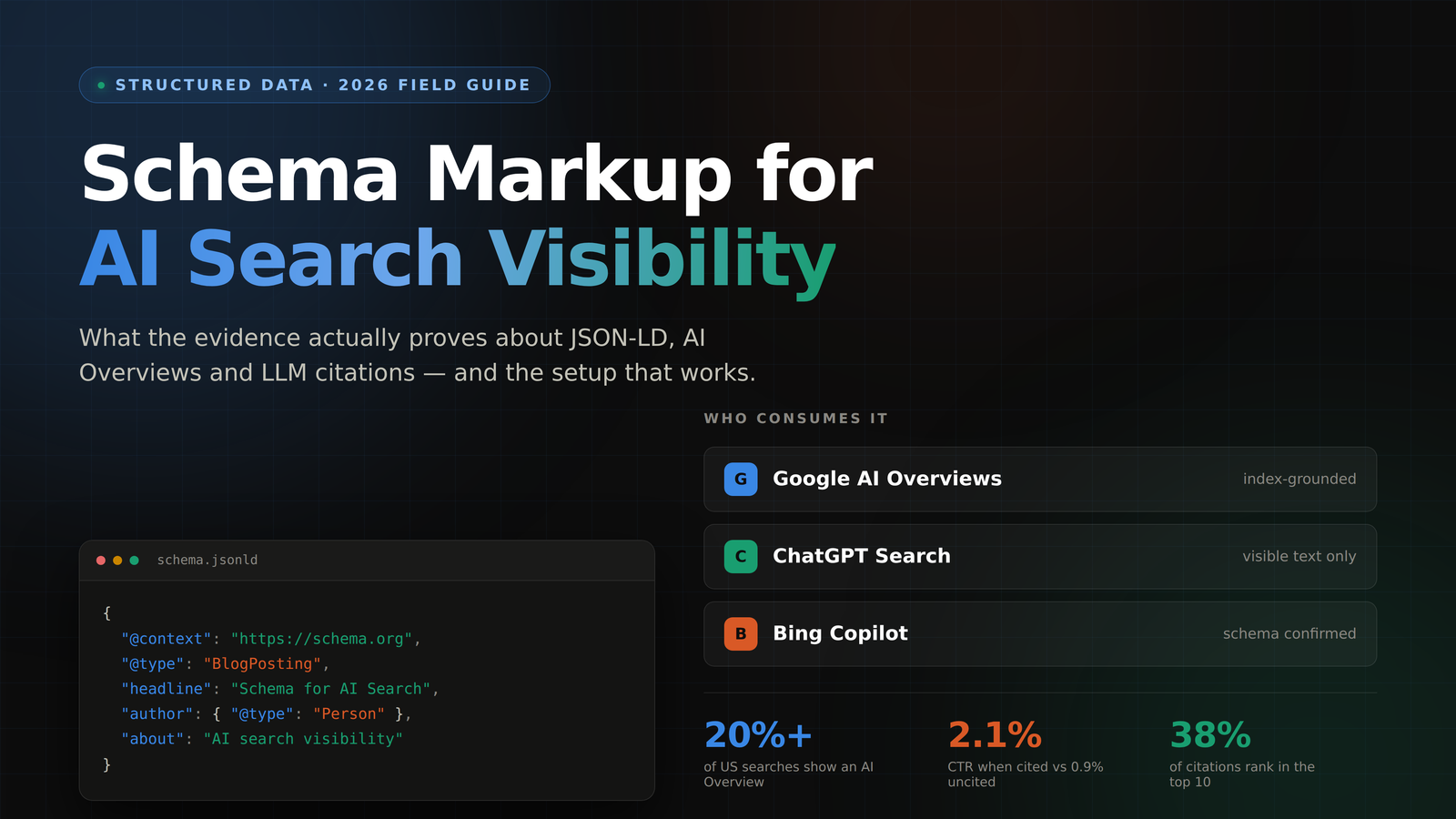
Partly — and only if you understand what it actually does. Schema markup reliably helps search engines index and classify your business, which is the gateway to Google’s AI Overviews and AI Mode. It does not appear to be read directly by ChatGPT or Claude when they fetch a live page. Microsoft has confirmed schema helps its LLMs; Google says no special schema is required for AI features. The honest position: schema is a strong foundation, not a magic switch.
What You Will Learn
- What schema markup and structured data are, in non-technical terms
- What the 2026 evidence really says about AI search visibility
- The best schema types for AI search visibility, ranked
- How to add JSON-LD structured data for AI search, step by step
- Whether FAQ schema still matters after Google dropped FAQ rich results
- Article schema vs FAQ schema for AI citations
- llms.txt vs schema markup — which one deserves your time
- How to test if AI can read your structured data
- A complete schema markup checklist for generative engine optimization
1. What Is Schema Markup? (And What Is Structured Data?)
Schema markup is a standardised vocabulary — maintained at Schema.org — that labels the information on your web page so machines can read it without guessing. Structured data is the broader term for any such machine-readable labelling. In practice, “schema markup” and “structured data for AI search” mean the same thing to most marketers.
Think of your web page as a shop window. A human walks past and instantly understands: this is a bakery, it opens at 7am, sourdough is £5. A machine sees only a wall of text. Schema markup is the label you stick on each item in the window — "@type": "Bakery", "openingHours": "Mo-Sa 07:00-17:00", "price": "5.00" — so the machine reads it the same way a human does.
Three things worth knowing up front:
- JSON-LD is the recommended format. It is a small block of code that sits in your page’s
<head> section. It does not change how your page looks to visitors.
- Schema must match visible content. Google explicitly requires that structured data reflects what is actually on the page. Marking up a review you do not display is a violation.
- Invalid schema is ignored entirely. A single missing bracket means the whole block is discarded. Validation is not optional.
The three formats, briefly
| Format |
Where it lives |
Use it? |
| JSON-LD |
A script block in the page head |
Yes — Google’s recommended format, easiest to maintain |
| Microdata |
Woven into your visible HTML tags |
Only if you inherited it |
| RDFa |
Woven into your visible HTML tags |
Rarely — legacy sites only |
2. What the 2026 Evidence Actually Says
Evidence is mixed and platform-dependent. Microsoft has said schema helps its LLMs. Google says structured data is an advantage in Search but that no special schema is needed for AI Overviews. Independent testing found that ChatGPT, Claude and Perplexity did not extract JSON-LD when fetching a live page. Schema’s value in 2026 is mostly indirect — it strengthens the classic index that AI features are built on.
Here is the record, without the hype.
What is confirmed in schema’s favour
- Google stated in April 2025 that structured data “gives an advantage” in search results.
- Fabrice Canel, Principal Product Manager at Microsoft Bing, confirmed at SMX Munich (March 2025) that schema markup helps Microsoft’s LLMs understand your content. He also recommended pushing fresh content via IndexNow, because generative AI systems place weight on freshness.
- A February 2024 Nature Communications study found that large language models extract information more accurately when given structured input with defined fields than when given unstructured text.
What cuts against the hype
- A December 2024 Search Atlas study found no correlation between schema coverage and AI citation rates.
- An October 2025 controlled test by Searchviu placed product prices only inside JSON-LD and asked each AI system to read them. The result: JSON-LD was not extracted by any system during a direct page fetch. Gemini found 50% of prices (it renders JavaScript and reads visible HTML), ChatGPT 37.5%, Google AI Mode 25%, Perplexity 12.5%, and Claude 0%. Every system that succeeded did so by reading visible content — not the markup.
- Google’s official AI features documentation states plainly: “There is no special schema.org structured data that you need to add” to appear in AI Overviews or AI Mode, and “You don’t need to create new machine readable files, AI text files, or markup to appear in these features.”
The practical takeaway
Schema markup is not how AI reads your page. Schema markup is how search engines classify and trust your page — and Google’s AI Overviews and AI Mode are grounded in that same index. So the chain is:
Good schema → better indexing and entity understanding → higher chance of being retrieved → higher chance of being cited.
Anyone selling you “schema markup for LLMs” as a direct citation lever is overstating the case. Anyone telling you to skip schema is ignoring that AI answers are still built on a search index.
3. Why AI Search Visibility Matters Right Now
AI-generated answers now sit above traditional results on a large share of searches, and they absorb the clicks. Being cited inside the answer is increasingly the only visibility that converts.
The numbers that should shape your budget:
- AI Overviews appear on 20%+ of US Google searches (SparkToro/Similarweb). By query type: comparisons 95%, questions 86%, informational 36%, transactional 5% (Seer Interactive, 49,353 queries).
- 68% of US Google queries ended without a click in early 2026, up from 60.45% two years earlier.
- Being cited roughly doubles your click-through rate. Seer Interactive (53 brands, 5.47M queries, Jan 2025–Feb 2026) found cited pages earned 2.1% CTR versus 0.9% for uncited pages on the same result.
- Only 38% of AI Overview-cited pages rank in the organic top 10 (Ahrefs, 863K keywords, 4M URLs, 2026) — down from 76% in July 2025. Roughly 31% of citations come from pages ranking 11–100.
- Generative AI platform visits grew 70% year-on-year to 9.5 billion monthly visits (Similarweb, June 2025–May 2026).
That fourth point is the important one for smaller businesses: you no longer need to rank in the top 10 to be quoted. Retrieval for AI answers is looser than classic ranking, which is exactly why clarity, structure and machine-readability now punch above domain authority.
4. Best Schema Types for AI Search Visibility (Ranked)
Prioritise Organization, Article/BlogPosting, Person, Product and LocalBusiness. These five carry entity, authorship and commercial meaning — the signals that decide whether a machine can identify who you are and what you sell.
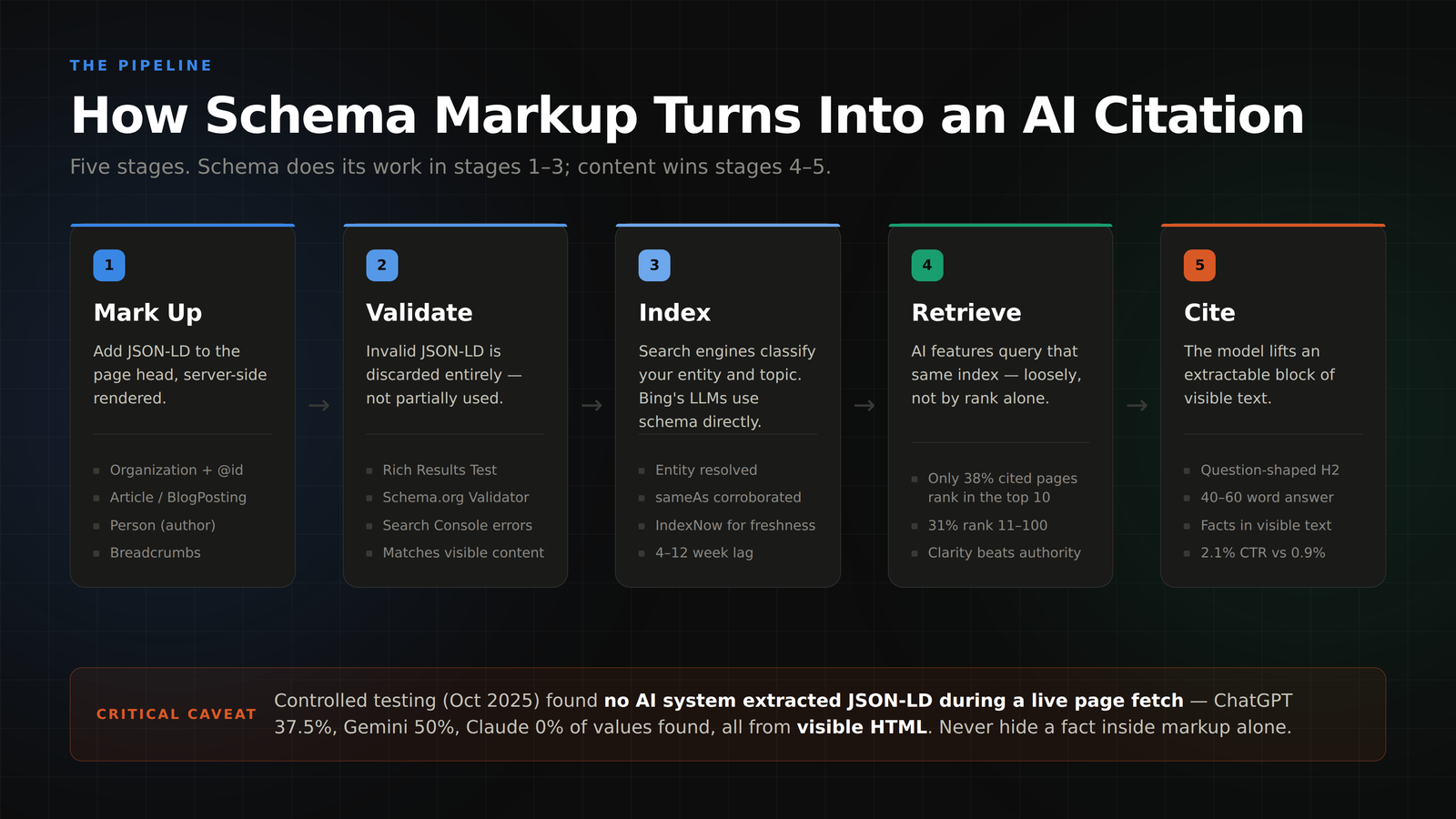
| Rank |
Schema type |
What it establishes |
Who needs it |
| 1 |
Organization |
Your brand as a recognised entity, with logo, socials and identifiers |
Every site |
| 2 |
Article / BlogPosting |
Content ownership, publish date, author, topic |
Any site publishing content |
| 3 |
Person |
Author identity and credentials (E-E-A-T) |
Any site with named authors |
| 4 |
Product + Offer + Review |
Price, availability, ratings, return policy |
E-commerce |
| 5 |
LocalBusiness + Place |
Address, hours, service area, phone |
Any business with a location |
| 6 |
BreadcrumbList |
Where a page sits in your site hierarchy |
Every multi-level site |
| 7 |
FAQPage |
Question-and-answer pairs |
Pages with genuine Q&A |
| 8 |
HowTo |
Sequential instructions |
Tutorial content |
| 9 |
VideoObject |
Video content and transcripts |
Sites with video |
| 10 |
DefinedTerm |
Glossary and terminology entries |
Reference / AEO content |
A note on AEO schema and generative engine optimization schema
You will see the terms AEO schema (Answer Engine Optimization) and generative engine optimization schema used as if they were new schema types. They are not. There is no @type: "AEO". Both terms describe a strategy — using the existing Schema.org vocabulary in a way that favours extractable, answer-shaped content. Anyone selling you a proprietary “AI schema” is selling you standard Schema.org with a new label.
5. Article Schema vs FAQ Schema for AI Citations
Article schema is the higher-value investment. It establishes authorship, freshness and topic — signals that survive Google’s 2026 deprecations. FAQPage schema no longer produces a rich result but still helps organise content into question-shaped blocks that AI systems can lift.
|
Article / BlogPosting |
FAQPage |
| Rich result in Google? |
Yes (Article features) |
No — removed 7 May 2026 |
| Still a valid Schema.org type? |
Yes |
Yes |
| Establishes authorship |
Yes (author, datePublished) |
No |
| Establishes entity / topic |
Yes (about, mentions) |
Weakly |
| Helps AI extraction |
Indirectly, via clarity |
Indirectly, via Q&A structure |
| Priority |
High |
Medium — keep it, do not build a strategy on it |
Verdict: implement Article schema on every content page. Keep FAQPage where you have genuine questions and answers, but understand that its value in 2026 comes from the content pattern it encourages — a clear question heading followed by a short direct answer — not from the markup itself.
6. FAQ Schema for AI Overviews After the May 2026 Change
On 7 May 2026 Google stopped showing FAQ rich results in Search. The FAQ search appearance, rich result report and Rich Results Test support were dropped in June 2026, with Search Console API support ending in August 2026. FAQPage markup remains valid and does no harm — Google has confirmed unused structured data does not cause problems.
What to do:
- Do not rip out your FAQ schema. There is no penalty, and it costs nothing to leave in place.
- Do keep writing FAQ sections. The format — question as a heading, 40–60 word answer directly beneath — is precisely what AI systems extract.
- Do stop reporting on FAQ rich result impressions. That data is gone.
- Note the same applies to HowTo. Google restricted HowTo rich results in August 2023 and has now fully deprecated them. The markup stays valid; the visual result is gone.
The single most important mental shift in this guide: the value has moved from the markup to the content pattern the markup describes.
7. How to Add JSON-LD Structured Data for AI Search (Step by Step)
Add a <script type="application/ld+json"> block to the <head> of each page, describing that page’s primary entity. Use @graph with @id values to link entities together. Validate before publishing.
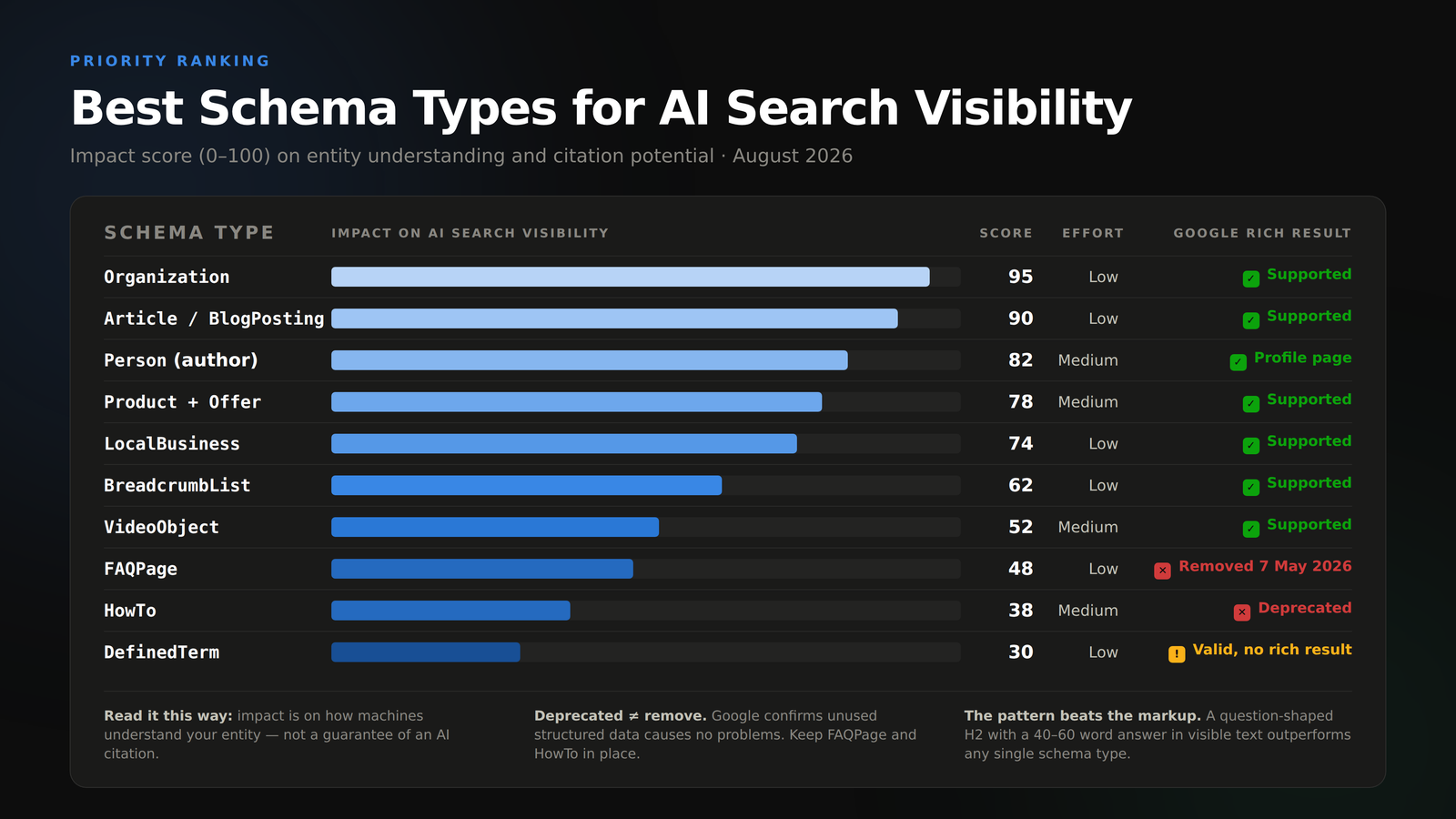
Step 1 — Mark up your organisation (site-wide)
This is your entity anchor. Add it to every page, or at minimum your homepage and about page.
<script type="application/ld+json">
{
  "@context": "https://schema.org",
  "@type": "Organization",
  "@id": "https://example.com/#organization",
  "name": "Example Company",
  "url": "https://example.com",
  "logo": "https://example.com/logo.png",
  "description": "One-sentence description of what your business does.",
  "foundingDate": "2015-03-01",
  "sameAs": [
    "https://www.linkedin.com/company/example",
    "https://x.com/example",
    "https://www.wikidata.org/wiki/Q000000"
  ]
}
</script>
The sameAs array is doing the heavy lifting here — it tells machines that this website, that LinkedIn page and that Wikidata entry are all the same entity.
Step 2 — Mark up the article and its author
<script type="application/ld+json">
{
  "@context": "https://schema.org",
  "@type": "BlogPosting",
  "@id": "https://example.com/blog/post-slug/#article",
  "headline": "Your Exact Page Title",
  "description": "One or two sentence summary.",
  "datePublished": "2026-08-20",
  "dateModified": "2026-08-20",
  "author": {
    "@type": "Person",
    "@id": "https://example.com/authors/jane-doe/#person",
    "name": "Jane Doe",
    "jobTitle": "Head of SEO",
    "url": "https://example.com/authors/jane-doe/",
    "sameAs": ["https://www.linkedin.com/in/janedoe"]
  },
  "publisher": { "@id": "https://example.com/#organization" },
  "mainEntityOfPage": "https://example.com/blog/post-slug/",
  "about": [
    { "@type": "Thing", "name": "Schema markup" },
    { "@type": "Thing", "name": "AI search visibility" }
  ]
}
</script>
Step 3 — Add breadcrumbs
<script type="application/ld+json">
{
  "@context": "https://schema.org",
  "@type": "BreadcrumbList",
  "itemListElement": [
    { "@type": "ListItem", "position": 1, "name": "Home", "item": "https://example.com/" },
    { "@type": "ListItem", "position": 2, "name": "Blog", "item": "https://example.com/blog/" },
    { "@type": "ListItem", "position": 3, "name": "Schema Markup for AI Search" }
  ]
}
</script>
Step 4 — Add FAQPage where you have real questions
<script type="application/ld+json">
{
  "@context": "https://schema.org",
  "@type": "FAQPage",
  "mainEntity": [{
    "@type": "Question",
    "name": "Does schema markup help with ChatGPT search?",
    "acceptedAnswer": {
      "@type": "Answer",
      "text": "Not directly. Controlled testing in October 2025 found ChatGPT did not extract JSON-LD during a live page fetch, reading only visible HTML. Schema still helps indirectly by improving how search indexes classify your page."
    }
  }]
}
</script>
Step 5 — Validate, then publish
Run every block through Google’s Rich Results Test and the Schema.org Validator. An invalid block is not partially used — it is discarded.
Doing this without touching code
If you are on WordPress, Shopify, Wix or Squarespace, you do not need a developer for the basics. Yoast SEO, Rank Math and Schema Pro all generate Organization, Article and Breadcrumb schema automatically. Shopify outputs Product schema by default. Your job is to fill in the fields properly — logo, social profiles, author bios — not to write the JSON.
8. Entity-Based Schema Markup for the Knowledge Graph
Entity-based markup connects your business to known things in Google’s Knowledge Graph using sameAs, @id and about. It is how you move from “a website that mentions accounting” to “a recognised accounting firm”.
Three moves, in order of impact:
- Give every entity a stable
@id. Use a URL fragment like https://example.com/#organization. Then reference it elsewhere instead of repeating the whole block. This creates a connected graph rather than isolated islands.
- Populate
sameAs with authoritative profiles. LinkedIn, Crunchbase, Wikidata, Companies House, industry directories. Each one is a corroborating signal that your entity is real.
- Use
about and mentions on content. about marks the page’s primary topic; mentions marks secondary topics. This is the closest thing to telling a machine “this page is genuinely about X”.
Combine all of these into a single @graph array rather than five separate script blocks — it is cleaner, and the relationships between entities become explicit.
9. Local Business Schema for AI Assistant Results
LocalBusiness schema supplies the facts AI assistants need to recommend you: address, hours, phone, service area and price range. Combined with an accurate Google Business Profile, it is the highest-leverage markup for any business with a physical location.
<script type="application/ld+json">
{
  "@context": "https://schema.org",
  "@type": "LocalBusiness",
  "@id": "https://example.com/#localbusiness",
  "name": "Example Dental Practice",
  "image": "https://example.com/storefront.jpg",
  "telephone": "+44-20-7946-0000",
  "priceRange": "££",
  "address": {
    "@type": "PostalAddress",
    "streetAddress": "12 High Street",
    "addressLocality": "London",
    "postalCode": "W1A 1AA",
    "addressCountry": "GB"
  },
  "geo": { "@type": "GeoCoordinates", "latitude": 51.5074, "longitude": -0.1278 },
  "openingHoursSpecification": [{
    "@type": "OpeningHoursSpecification",
    "dayOfWeek": ["Monday","Tuesday","Wednesday","Thursday","Friday"],
    "opens": "09:00", "closes": "17:30"
  }],
  "areaServed": { "@type": "City", "name": "London" }
}
</script>
Use the most specific subtype available — Dentist, Restaurant, Plumber — rather than generic LocalBusiness. Specificity is the whole point. And make sure your name, address and phone number match your Google Business Profile character for character; Google’s own AI guidance explicitly calls out keeping your Business Profile updated.
10. Product Schema Markup for AI Shopping Results
Product schema with Offer and AggregateRating supplies price, availability, ratings and return policy — the exact fields AI shopping experiences compare across sellers. Since November 2025 Google requires a returnPolicyCountry field on return policy markup.
<script type="application/ld+json">
{
  "@context": "https://schema.org",
  "@type": "Product",
  "name": "Merino Wool Crew Sweater",
  "image": ["https://example.com/sweater.jpg"],
  "description": "100% merino wool, machine washable.",
  "sku": "MW-CREW-001",
  "brand": { "@type": "Brand", "name": "Example" },
  "aggregateRating": {
    "@type": "AggregateRating", "ratingValue": "4.6", "reviewCount": "218"
  },
  "offers": {
    "@type": "Offer",
    "url": "https://example.com/products/merino-crew",
    "priceCurrency": "GBP",
    "price": "89.00",
    "availability": "https://schema.org/InStock",
    "hasMerchantReturnPolicy": {
      "@type": "MerchantReturnPolicy",
      "returnPolicyCountry": "GB",
      "returnPolicyCategory": "https://schema.org/MerchantReturnFiniteReturnWindow",
      "merchantReturnDays": 30
    }
  }
}
</script>
Critical caveat: remember the Searchviu finding. Prices hidden only inside JSON-LD were not extracted by any AI system. So put the price, the rating and the availability in visible on-page text as well. The markup is for the index; the visible text is for the AI.
11. Author Schema Markup for E-E-A-T and AI Trust
Person schema links content to a real, verifiable human with credentials. In a search environment flooded with AI-generated content, demonstrable authorship is one of the few remaining trust differentiators.
What to include for each author:
- A dedicated author page at a stable URL
name, jobTitle, worksFor (referencing your Organization @id)sameAs pointing to LinkedIn, ORCID, a professional body, published workknowsAbout listing genuine areas of expertisealumniOf or hasCredential where relevant
Then reference that Person @id from every article they write. One well-built author entity referenced across fifty articles is worth far more than fifty anonymous bylines.
12. llms.txt vs Schema Markup for AI Visibility
Schema markup wins decisively. Google confirmed in May 2026 that llms.txt has no effect on AI Overviews, AI Mode or generative Search features. Schema markup, by contrast, feeds the index those features are built on.
|
Schema markup |
llms.txt |
| Google support |
Yes — official documentation and tooling |
No — listed as a tactic to ignore (May 2026) |
| Bing / Copilot |
Confirmed to help their LLMs |
No confirmation |
| OpenAI / Anthropic |
Not confirmed for retrieval |
Both publish their own llms.txt files for developer docs |
| Adoption |
Tens of millions of sites |
~30,000–60,000 files indexed globally (Wix Studio, Oct 2025) |
| Effort |
Medium, one-off |
Low |
| Verdict |
Do this |
Optional; useful mainly for documentation sites |
John Mueller compared llms.txt to the old keywords meta tag, noting that no AI services requested the file. Gary Illyes confirmed Google was not pursuing it. If you run developer documentation, an llms.txt file is a reasonable ten-minute investment because Anthropic recommends it for agent-facing docs and Perplexity has been observed surfacing it. For everyone else, it is not where your next hour should go.
13. How to Test If AI Can Read Your Structured Data
Validate the markup first, then test extraction separately. Valid schema only proves the code parses — it does not prove an AI system used it.
Step 1 — Validate the code
- Google Rich Results Test (
search.google.com/test/rich-results) — shows which Google features your page qualifies for
- Schema.org Validator (
validator.schema.org) — catches vocabulary errors Google’s tool ignores
- Google Search Console → Enhancements — surfaces errors across your whole site
Step 2 — Check the raw HTML
View the page source (not the rendered DOM) and confirm your JSON-LD is present. If your schema is injected by JavaScript after load, several AI crawlers will never see it. Server-side rendering matters more than the markup itself.
Step 3 — Test extraction directly
Paste your URL into ChatGPT, Claude, Gemini and Perplexity and ask specific factual questions the page answers — “What is the price?”, “Who wrote this and what are their credentials?”, “What are the opening hours?” If the answer is wrong or absent, that fact is not reachable. Nine times out of ten the fix is to put it in visible text.
Step 4 — Monitor citations over time
Track brand mentions in AI answers using Ahrefs Brand Radar, Profound, Otterly or similar. Establish a baseline before you change anything, or you will have no way to attribute results.
14. Schema Markup Checklist for Generative Engine Optimization
Foundations
- Organization schema on every page, with logo and
sameAs profiles
- BreadcrumbList on every page below the homepage
- Article or BlogPosting on every content page
- Person schema for every author, with a real author page
- LocalBusiness (most specific subtype) if you have a location
- Product + Offer if you sell online
Entity work
- Stable
@id for every entity
- Entities combined in a single
@graph
sameAs populated with at least three authoritative profilesabout and mentions set on key pages
Content pattern — where the real AI wins live
- Every H2 phrased as a question a real person would ask
- A 40–60 word direct answer immediately beneath every H2
- Key facts (price, hours, stats) in visible text, not only in markup
- Comparison tables for any “X vs Y” question
- Dates, sources and figures cited inline
- Content rendered server-side, not injected by JavaScript
Validation and monitoring
- Every block passes Rich Results Test and Schema.org Validator
- Schema matches visible content exactly
- Search Console structured data errors at zero
- IndexNow configured for fast recrawl of updates
- AI citation baseline recorded before changes
- Quarterly review — this field changes fast
15. The Five Mistakes That Waste Schema Budget
- Marking up content that is not visible. It violates Google’s guidelines and, per the 2025 testing, AI systems will not read it anyway.
- Building a strategy on FAQ rich results. They stopped appearing on 7 May 2026.
- Injecting schema with JavaScript. Several AI crawlers do not execute JavaScript. Render server-side.
- Isolated schema blocks with no
@id links. You get a pile of facts instead of a connected entity graph.
- Publishing without validating. One malformed bracket discards the entire block, silently.
Frequently Asked Questions
Does schema markup help with ChatGPT search?
Not directly. Controlled testing in October 2025 found that ChatGPT did not extract data present only in JSON-LD when fetching a live page — it read visible HTML only, finding 37.5% of test values. Schema still helps indirectly by improving how search indexes classify and retrieve your content.
How do I get cited in AI Overviews with structured data?
Structured data alone will not do it. Combine valid Article, Organization and Person schema with question-shaped H2 headings, 40–60 word direct answers, facts in visible text, and server-side rendering. Being cited roughly doubles CTR — 2.1% versus 0.9% for uncited pages on the same result.
Should I remove my FAQ schema now that rich results are gone?
No. Google has confirmed unused structured data causes no problems in Search, and FAQPage remains a valid Schema.org type. Keep it, but stop measuring FAQ rich result impressions and do not build new strategy around it.
What is the difference between AEO schema and normal schema markup?
Nothing, technically. AEO (Answer Engine Optimization) and generative engine optimization describe how you use the standard Schema.org vocabulary — favouring answer-shaped, extractable content. There is no separate “AEO schema” type.
Do I need llms.txt as well as schema markup?
Only if you run developer documentation. Google’s May 2026 guidance explicitly lists llms.txt among tactics site owners can ignore, and John Mueller compared it to the obsolete keywords meta tag. Schema markup is the better investment.
How long until schema markup affects AI search visibility?
Expect four to twelve weeks. Your pages must be recrawled and reindexed before any change can influence retrieval. Using IndexNow shortens the recrawl step considerably.
Can I add schema markup without a developer?
Yes, for the basics. Yoast SEO, Rank Math and Schema Pro handle Organization, Article and Breadcrumb schema on WordPress; Shopify outputs Product schema by default. Custom entity graphs with linked @id values usually need developer help.
Conclusion
Schema markup in 2026 is infrastructure, not a growth hack. The evidence does not support the claim that AI assistants read your JSON-LD directly — most of them demonstrably do not. What the evidence does support is that structured data makes your business legible to the search index that Google’s AI features are built on, and that Microsoft’s LLMs use it directly.
So implement it properly, once, and then spend the rest of your effort on the thing that actually moves AI citations: clear question-shaped headings, short factual answers in visible text, and a website that a machine can read without running JavaScript.
Do the markup because it is cheap, permanent and removes ambiguity. Win the citations with the content.
Not sure whether your schema is actually working? Get a free 15-minute structured data audit — we will validate your markup, check what AI systems can read on your site, and send you a prioritised fix list.
Request your free schema audit →



Comments (0)